Why Private Schools Lose Enrollment
For many private schools, declining enrollment is one of the most pressing challenges they face. A shrinking student population affects far more than the bottom line—it influences staffing, program offerings, campus investment, reputation, and ultimately, the long-term sustainability of the school.
While external factors such as economic conditions, demographic shifts, and government policy undoubtedly play a role, many schools overlook a more important truth: enrollment decline is often driven by internal factors that can be identified, measured, and improved.
Schools that consistently maintain healthy enrollment rarely succeed by chance. They deliberately invest in strategic leadership, compelling marketing, strong admissions processes, exceptional parent experiences, and continuous improvement. Conversely, schools that experience declining numbers often discover that enrollment problems have been developing quietly over several years before they begin to affect school operations.
Understanding why private school enrollment declines is the first step towards reversing the trend. More importantly, recognizing the warning signs early allows school leaders to implement sustainable strategies before financial pressure begins affecting educational quality.
This article explores the most common reasons private schools lose enrollment, practical examples from private schools, and the actions school leaders can take to build a stronger future.

Increasing Enrollment
Enrollment Is an Outcome, Not a Department
One of the biggest misconceptions in education is that admissions teams are solely responsible for filling classrooms.
In reality, private school admissions reflect the overall health of the entire organization.
Every interaction influences enrollment:
Leadership decisions
Community engagement
Marketing effectiveness
Parent communication
School reputation
Academic outcomes
Financial policies
Student wellbeing
Staff culture
Families rarely choose a school because of a brochure alone. They choose schools because they trust the experience the school promises to deliver.
Admissions teams can only market what actually exists.
When enrollment falls, it is therefore essential to look beyond the admissions office and examine the broader school ecosystem.
1. Schools Lose Their Clear Identity
Parents have more educational choices than ever before.
Private schools now compete with:
Other private schools
High-performing government schools
Charter schools
Faith-based schools
Online learning providers
Specialist academies
International schools
If a school cannot clearly explain why it is different, families struggle to justify paying tuition fees.
Many schools rely on generic statements such as:
Excellence in education
Caring community
Academic achievement
Holistic learning
Individual attention
Unfortunately, almost every school says exactly the same thing.
Families want specificity. Metrics matter, families can compare metrics.
Schools with a distinctive value proposition consistently perform better in private school enrollment because parents understand precisely what makes them unique.

Private school class
2. Admissions Processes Create Friction
Parents increasingly expect the same level of service they receive from banks, airlines, healthcare providers, and retailers.
Yet many admissions processes remain unnecessarily difficult.
Common frustrations include:
Slow responses to enquiries
Complicated application forms
Poor communication
Long waiting periods
Confusing fee structures
Limited tour availability
Lack of follow-up
Every additional barrier increases the likelihood that prospective families will enquire elsewhere.
Consider two schools.
School A responds to an online enquiry five days later with a generic email.
School B calls the family within two hours, answers questions, schedules a personalized campus tour, introduces the Head of School, and sends follow-up resources tailored to the family's interests.
Even if both schools offer similar academic programs, School B has already created a stronger relationship.
Exceptional private school admissions begin with exceptional customer service.
3. The School's Reputation No Longer Matches Parent Expectations
Reputation takes years to build but can change surprisingly quickly.
Parents now research schools extensively before making contact.
They examine:
Online reviews
Social media
Community forums
Parent recommendations
News articles
Academic performance
Student wellbeing initiatives
Schools that fail to actively manage their reputation often discover that outdated perceptions continue influencing prospective families.
For example, a school may have significantly improved leadership and academic performance, yet parents still associate it with challenges from several years earlier.
Reputation management requires intentional storytelling.
Schools should regularly communicate:
Student achievements
Teacher expertise
Graduate success
Community partnerships
Innovation
Parent testimonials
Student experiences
If schools fail to tell their own story, others will tell it for them.
4. Marketing Focuses on the School Instead of Parents
Many school websites describe facilities, history, curriculum, and buildings.
Parents, however, are asking different questions:
Will my child belong here?
Will my child succeed?
Will teachers know my child personally?
Will this school prepare them for the future?
Effective marketing answers family concerns rather than listing school features.
Instead of writing:
"We offer small class sizes."
Explain the benefit:
"Small classes allow teachers to know every student personally, identify learning needs early, and provide individual support that helps students grow in confidence."
Parents buy outcomes.
Not features.

Enrollment Challenges
5. Schools Ignore Demographic Changes
Population patterns continually evolve.
Neighborhoods age.
New housing developments emerge.
Migration patterns shift.
Birth rates fluctuate.
Schools that rely on historical enrollment patterns may suddenly discover that fewer school-aged children live within their traditional catchment area.
Forward-thinking schools regularly analyze:
Local demographics
Birth data
Housing developments
Competitor growth
Transport access
Family income trends
This information enables schools to adjust recruitment strategies before enrollment begins declining.
Strategic planning should always include demographic forecasting.
6. Tuition Fees Outpace Perceived Value
Most parents understand that private education requires significant investment.
However, they expect that investment to deliver clear value.
When annual fee increases occur without visible improvements, families begin questioning affordability.
Value extends beyond academic outcomes.
Parents evaluate:
Facilities
Safety
Student support
Co-curricular programs
Technology
Communication
Leadership
Community
Schools that clearly communicate how tuition supports student outcomes are more likely to retain families during periods of economic pressure.
Transparency builds trust.
7. Existing Families Leave Quietly
Many schools invest heavily in attracting new students while overlooking current families.
Retention is often more cost-effective than recruitment.
Unfortunately, dissatisfaction rarely appears overnight.
Parents may experience:
Communication frustrations
Unresolved concerns
Declining confidence
Poor customer service
Limited engagement
Instead of raising complaints, many simply decide not to return the following year.
Exit interviews frequently reveal issues that could have been addressed much earlier.
Schools should regularly measure parent satisfaction through surveys, listening sessions, and proactive conversations.
Retention deserves the same strategic attention as recruitment.

Student enrollment
8. Leadership Becomes Reactive Instead of Strategic
Enrollment rarely declines because of one single event.
It usually reflects years of accumulated decisions.
When leadership teams spend most of their time responding to immediate operational challenges, strategic planning related to marketing often receives insufficient attention.
Questions every leadership team should regularly ask include:
Where will enrollment come from in five years?
Which programs drive demand?
Which year levels experience the greatest attrition?
What differentiates us from competitors?
What do parents value most?
Which investments will improve future enrollment?
Schools that ask these questions consistently make stronger long-term decisions.
9. Data Is Collected but Not Used
Private schools often collect enormous amounts of information without translating it into action.
Useful enrollment data includes:
Enquiry sources
Tour attendance
Application conversion rates
Acceptance rates
Yield
Retention
Withdrawal reasons
Parent satisfaction
Website performance
Patterns quickly emerge when data is reviewed consistently.
For example, if applications remain strong but enrollments decline, the issue may lie within offer conversion rather than marketing.
If enquiries fall sharply, awareness may be the challenge.
Good decisions depend on good evidence.
10. Schools Resist Change
Education is changing rapidly.
Parent expectations continue evolving.
Technology reshapes communication.
Student wellbeing receives greater attention.
Career pathways diversify.
Schools that continue operating exactly as they did ten years ago often struggle to remain competitive.
This does not mean abandoning tradition.
Successful schools honor their heritage while continuously improving their educational offering and family experience.
Innovation can include:
Modern admissions technology
Contemporary communication strategies
Flexible learning opportunities
Enhanced wellbeing programs
Parent engagement initiatives
Industry partnerships
Adaptability is becoming a defining characteristic of successful schools.
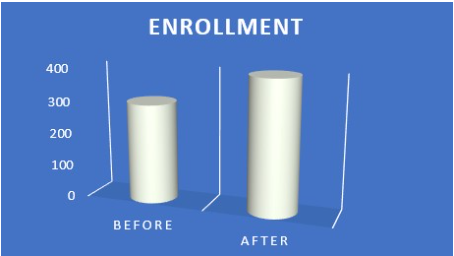
Increased Enrollment
Practical Example: Turning Around Enrollment
Consider a private school experiencing three consecutive years of declining enrollment.
Initial assumptions blamed economic conditions.
However, a comprehensive review revealed several internal challenges:
Website enquiries received responses after four days.
Campus tours occurred only once each month.
Parent testimonials were outdated.
No follow-up process existed after tours.
Marketing highlighted facilities instead of student outcomes.
Parent satisfaction surveys had not been conducted for five years.
None of these issues required constructing new buildings or launching expensive programs.
Instead, the school focused on improving responsiveness, refining messaging, strengthening communication, modernizing its admissions journey, and engaging current families more effectively.
Within two admission cycles, enquiry conversion improved significantly, retention increased, and overall enrollment returned to sustainable growth.
The lesson was clear.
Small operational improvements often produce substantial enrollment gains.
Building Sustainable Enrollment Growth
Improving private school enrollment requires more than increasing advertising expenditure.
Sustainable growth comes from aligning every part of the organization around the family experience.
High-performing schools typically focus on several priorities simultaneously:

Student Enrollment
Clarify Your Value Proposition
Every staff member should be able to explain what makes the school genuinely distinctive.
Strengthen Private School Admissions
Admissions should feel welcoming, responsive, personal, and efficient from first enquiry through enrollment.
Invest in Parent Relationships
Happy families become powerful ambassadors who generate referrals and strengthen community reputation.
Measure What Matters
Track meaningful enrollment metrics and use data to guide decisions.

Enrollment Challenges
Build Leadership Capacity
Boards, Heads of School, and senior leaders should view enrollment as a strategic priority rather than an operational responsibility.
Commit to Continuous Improvement
The strongest schools continually evaluate their practices, seek feedback, and adapt to changing family expectations.
Why Enrollment Strategy Matters More Than Ever
Today's educational landscape is increasingly competitive.
Families have greater choice, greater access to information, and higher expectations than ever before.
Schools that thrive are those that deliberately align educational excellence with exceptional leadership, effective communication, strategic marketing, and outstanding family experiences.
The encouraging news is that most enrollment challenges are solvable.
Schools cannot control demographic trends or economic conditions, but they can control how they position themselves, communicate their value, engage prospective families, retain current students, and strengthen organizational performance.
The most successful schools recognize that enrollment is not simply about filling classrooms. It is about building a sustainable institution capable of delivering outstanding education for generations to come.
Every improvement made today strengthens tomorrow's reputation, community confidence, and long-term financial sustainability.
Partner with ISPG to Strengthen Your School's Future
If your school is experiencing declining enrollment—or if you want to build a proactive strategy before challenges emerge—ISPG can help.
Our team works alongside Heads of School, Boards of Directors, and school owners to identify the factors influencing private school enrollment, optimize private school admissions, strengthen governance, refine strategic positioning, and create practical, evidence-based enrollment strategies that deliver lasting results.
Whether you are seeking to improve admissions performance, increase student retention, clarify your school's value proposition, or develop a long-term sustainability plan, ISPG provides the expertise and guidance to help your school thrive in an increasingly competitive environment.
Contact ISPG today to discover how we can help your school increase enrollment, strengthen financial sustainability, and build a resilient future for your students, staff, and community.